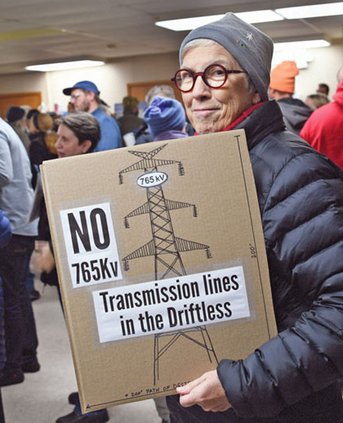
In the swirling wave of opposition to the siting and construction of the state’s largest electric transmission line (MariBell 765kV) in Vernon and Crawford counties, the fight seems to be moving toward the courts and ‘lawyering up.’
Last week, a lawsuit was filed in Vernon County Circuit Court seeking to block siting and construction of the line in Vernon and Crawford counties. A non-profit group for potentially impacted landowners has formed. The group’s members are potentially affected landowners with an existing 161 kV transmission line easement on their property.
The ‘Citizens Against Maribel 765’ (CAM765) group has hired attorneys Erik Olsen, Andrew Weininger, and Sarah Olsen of the Eminent Domain Services, LLC law firm to represent them. The recently formed group is raising funds through membership fees. As yet, no court dates have been announced.
“As property owners in Wisconsin, citizens are afforded rights,” CAM 765 President Tim Woodhouse commented. “The complaint filed in Vernon County Circuit Court lays out our concerns, and is an exercise in protecting those rights.”
As announced at the Vernon County General Government Committee meeting last week, Vernon and Crawford counties are also considering a limited-scope, mutual relationship with an attorney who can coach the two counties in navigating the permitting process with PSC. The Vernon County Town of Genoa is also considering hiring an attorney.
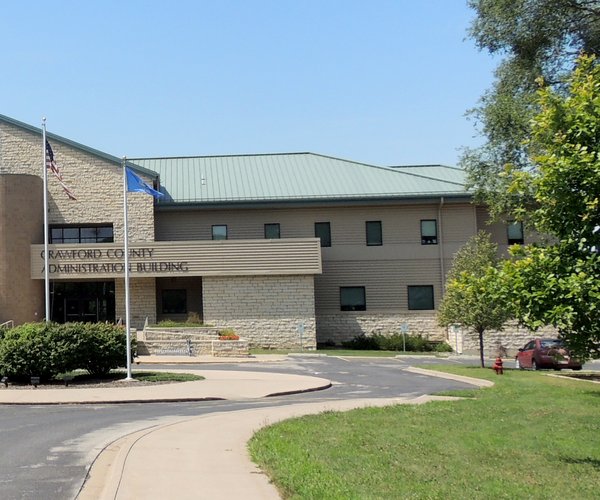
Crawford County Land Conservation Committee Chairperson Supervisor Gary Koch provided a brief update at their May 12 meeting.
“I’ve been in discussion with our county corporate counsel, Mark Peterson. He has been talking with county corporate counsel in Vernon County, and discussing how they would propose to support the counties at the PSC level,” Koch reported. “We’re doing more behind the scenes work to try to figure out exactly what the best options are for the two counties. Mark said he would let me know if they came up with something the committee could look at doing, some sort of resolution in opposition to the line, and how we would proceed with that opposition to the PSC. And I haven’t heard anything yet.
“It was pretty evident at our April County Board meeting when the line people came to make their presentation, that there was not a lot of support for that line to be run through. Especially northern board members, where that line is going to go through, were adamantly opposed. So, I’ve got a feeling that if they drive this siting, that’s probably where Crawford County as a whole is going. The companies are still not providing enough information to the people who want that information, property owners and anybody who’s asking,” Koch concluded.
No 765 Line group
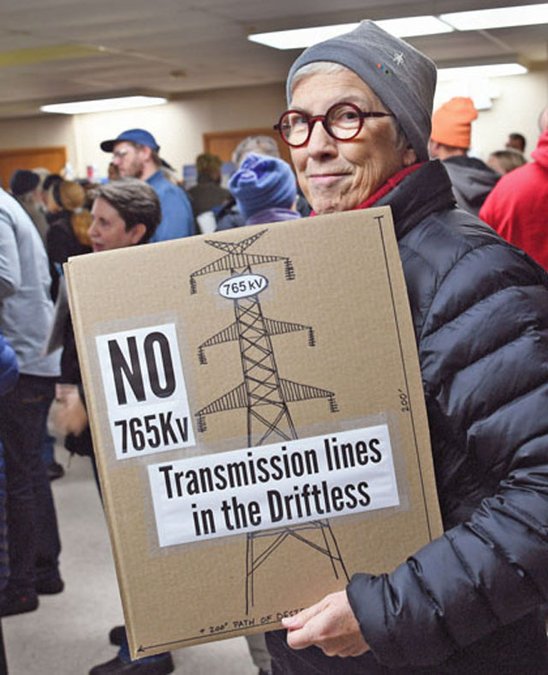
At the same time, the public awareness campaign on behalf of the ‘No 765 Line’ group continues, with efforts turning toward fundraising, outreach, public relations, and hiring of expert witness intervenors in the upcoming permitting process with the Public Service Commission of Wisconsin (PSC).
The group is in the process of incorporating as a 501C3 non-profit, which can accept tax-deductible donations to support their efforts in landowner outreach, yard signs and banners, advertising, and more. Eventually, there will be an online donation portal, but for now, donations can be sent to P.O. Box 1, Seneca, WI, 54654. Checks should be made payable to: No 765 Line, Inc.
‘No 765 Line’ yard signs will be available later in May. To reserve yours, send a check for $20 made payable to ‘No 765 Line, Inc.’ to P.O. Box 1, Seneca, WI, 54654.
The group is also in the process of forming a website, and more information will become available about that in coming weeks.
The two groups have formed as separate and distinct, not-for-profit organizations, each with their own board of directors. They have no formal relationship with each other.
Lawsuit complaint
The complaint in the lawsuit filed by Vernon County Circuit Court on behalf of Citizens Against Maribel 765 reads as follows:
Now comes Plaintiff COALITION AGAINST MARIBEL 765, INC. by its attorneys Erik Olsen, Andrew Weininger, and Sarah Olsen of Eminent Domain Services, LLC, and alleges and pleads as follows for its COMPLAINT:
1) Plaintiff COALITION AGAINST MARIBEL 765, INC. is a nonstock corporation formed under the laws of the State of Wisconsin with its registered office at the above-captioned address which was formed in 2026 and whose board and supporting members own land that would be directly impacted by the MariBell Transmission Project if it is constructed thereon.
2) Plaintiff has supporting members of the nonstock corporation who are landowners who would be impacted by the proposed MariBell Transmission Project.
3) DAIRYLAND POWER COOPERATIVE, is a Wisconsin cooperative association located at 3200 East Avenue South, La Crosse, Wisconsin 54601.
4) GRIDLIANCE HEARTLAND, LLC is a foreign limited liability company with its principal office located at 700 Universe Boulevard, Juno Beach, Florida 33408.
5) The Defendants are planning to construct a 139-mile, 765 kilovolt (kV) / 161 kV double circuit transmission line in Minnesota and Wisconsin (“the MariBell Transmission Project” or “the Project”).
6) On May 8th of 2025, Dairyland issued the following statement: “Dairyland Power Cooperative and GridLiance Heartland, LLC (GridLiance), a subsidiary of NextEra Energy Transmission, LLC, have reached an agreement to jointly develop and co-own the MariBell Transmission Project, a 139-mile, 765 kilovolt (kV) / 161 kV double circuit transmission line in Minnesota and Wisconsin. The 139-mile segment, which extends from Marion, Minn., to Bell Center, Wis., is a portion of a new 273-mile, 765 kV transmission line, and spans six counties in the two states.”1
7) The Vernon Reporter reported that the Defendants held public information type meetings in November of 2025 and March of 2026 on the topic of the MariBell Transmission Project.
8) The MariBell Transmission Project would be built in Vernon and Crawford Counties on routes that are shown in the attached Exhibit A which is published by the Defendants and which is incorporated herein by reference.
9) At the public information meetings, the Defendants informed the public that they intended to construct steel transmission line towers two hundred feet in height to hold their planned 765 kilovolt (kV) / 161 kV double circuit transmission line.
10) The right of way of the planned 765 kilovolt (kV) / 161 kV double circuit transmission line would be 250 feet in width.
11) The planned 765 kilovolt (kV) / 161 kV double circuit transmission line would be the largest transmission line ever constructed in the State of Wisconsin and possibly in the midwest.
12) On March 8th of 2026, the Vernon Reporter published the following diagram depicting how the proposed 765 kilovolt (kV) /161 kV double circuit transmission line would compare to existing transmission lines in the region:
13) Wisconsin’s driftless area is one of the most beautiful ecological and geographical treasures in the world, known for being home of the driftless area and also the Great River Road. 14) The Driftless Area is also described as Ecoregion 52, and its Driftless name, comes from the fact that because this area was not covered by the last glacier it is characterized by bluffs, steep rocky hills, river valleys, waterfalls, world class trout streams, ravines, and rapidly changing elevations. 15) The Driftless Area is further described in the publication The Driftless Area: The Extent of Unglaciated and Similar Terrains in Wisconsin, Illinois, Iowa, and Minnesota, Carson, E.C.; Curry, B.B.; Kerr, P.J.; Lusardi, B.A.; 2023, which is incorporated herein by reference and is available online.2
16) The Defendants are planning to build their Project through the Driftless Area. 17) The Project infrastructure will irreversibly damage, scar, and destroy the unglaciated Driftless landscape. 18) There are also numerous Native American mounds, as well as other historic and pre-historic resources, in the project area and these would be damaged, diminished, and/or destroyed by the MariBell Transmission Project.
19) The Project would construct high voltage transmission lines and high voltage transmission lines are widely believed to cause stray voltage and diseases such as brain cancers and leukemia.
20) The Project would construct high voltage transmission lines that emit an annoying buzzing or humming sound which is much louder at some times than at others.
21) Due to the visual offensiveness of the proposed high voltage transmission line facilities, the concerns about disease, and the irritating buzzing and humming, the transmission lines cause land and business values to diminish or in some cases even to become valueless.
22) The Project infrastructure will threaten families’ homes, farms, and businesses, and devalue a vast swath of property throughout Vernon and Crawford Counties.
23) The Project will cause the homes and properties of the Plaintiff’s supporting members to lose significant percentages of their value.
24) The Project will cause the Plaintiff and its members to experience fear and worry and will cause them to no longer be able to feel safe and will make them feel uncomfortable on their own properties and force some members to move from their properties.
25) Over the past 20 years, conservation and responsible use has caused Wisconsin to be able to reduce electricity usage by approximately 9%. https://www.wpr.org/news/data-center-boom-follows-declining-electricity-water-use-wisconsin
26) If it were not for the construction of data centers in Wisconsin there would be no need whatsoever for the MariBell Transmission Project.
27) The MariBell Transmission Project will cause the Plaintiff and the Plaintiff’s supporting members’ electricity bills to increase.
28) The MariBell Transmission Project sacrifices a beautiful rural region of Vernon and Crawford Counties in order to funnel electricity to massive tech data centers and other large energy users.
29) The MariBell Transmission Project offers no local benefit, among other reasons because local residents’ electricity bills will increase and whatever economic payments the Project may cause to be made locally are dwarfed by the economic and environmental harm that the Project will wreak on Vernon and Crawford Counties.
FIRST CAUSE OF ACTION - ANTICIPATORY NUISANCE STRICT LIABILITY
30) The Defendants’ proposed conduct will create a private nuisance by invading or interfering with Plaintiff’s or Plaintiff’s members’ interest(s) in the private use and enjoyment of their land.
31) The invasion or interference will result in significant harm.
32) The Defendants’ proposed conduct is an abnormally dangerous activity because there is: (a) the existence of a high degree of risk of some harm to another’s interest in the private use and enjoyment of land; (b) likelihood that the harm that results from it will be great; (c) inability to eliminate the risk by the exercise of reasonable care; (d) the Project is not a matter of common usage; (e) the proposed Project is a completely inappropriate use for the place where the Defendants are proposing to carry it on; and (f) the Project’s value to the community is vastly outweighed by the Project’s dangerous attributes.
33) The Defendants’ proposed conduct will ‘necessarily’ or ‘certainly’ create a nuisance.
34) The resulting nuisance will cause the Plaintiff and its members harm that is inevitable and undoubted.
SECOND CAUSE OF ACTION - ANTICIPATORY NUISANCE NEGLIGENCE
35) The Defendants’ proposed conduct will create a private nuisance by invading or interfering with Plaintiff’s or Plaintiff’s members’ interest(s) in the private use and enjoyment of their land.
36) The invasion or interference will result in significant harm.
37) The Defendants’ proposed course of conduct is negligent because a reasonable person would recognize that the Project creates an unreasonable risk of invading or interfering with the Plaintiff and its members’ use or enjoyment of their property.
38) The Defendants’ proposed course of conduct would be the cause of the nuisance that would invade or interfere with the Plaintiff’s or Plaintiff’s members’ interest(s) in the private use and enjoyment of their land.
39) The Defendants’ proposed conduct will ‘necessarily’ or ‘certainly’ create a nuisance.
40) The resulting nuisance will cause the Plaintiff and its members harm that is inevitable and undoubted.
THIRD CAUSE OF ACTION - DECLARATORY RELIEF
41) The Plaintiff additionally requests that this Court grant declaratory relief under Wis. Stat. § 806.04 and declare that because a) the Project will not provide any benefit to the inhabitants of Vernon or Crawford Counties; b) that the Project is not needed but for the desire to build data centers and supply electricity to them; and c) that the Project will constitute a nuisance to the Plaintiff and the Plaintiff’s supporting members.
42) Plaintiff requests that this Court grant supplemental declaratory relief under Wis. Stat. § 806.04(8) as the Court may find to be appropriate after the trial of this matter.
Wherefore, the Plaintiff prays for judgment in the following forms:
a) An injunction ordering the Defendants to either cease and desist from the Project or to redesign it so that it will not cause a nuisance.
b) Declaratory relief under Wis. Stat. § 806.04 and declare that the Project will not provide any benefit to the inhabitants of Vernon or Crawford Counties.
c) Declaratory relief under Wis. Stat. § 806.04 that there is no public need for the Project but for corporate desire to build data centers and the attendant need for electricity to be supplied to them.
d) Declaratory relief under Wis. Stat. § 806.04 that the Project will constitute a nuisance to the Plaintiff and the Plaintiff’s supporting members.
e) For such other relief as available and appropriate under the statutes cited in this complaint.
f) Whatever other or additional relief the Court may find to be just and equitable.
Note: declaratory relief is a court-issued judgment that officially defines legal rights, obligations, or status of parties in a dispute without awarding damages or ordering specific action. It acts as a ‘preventative’ legal tool, allowing parties to clarify their rights before a breach or lawsuit occurs.