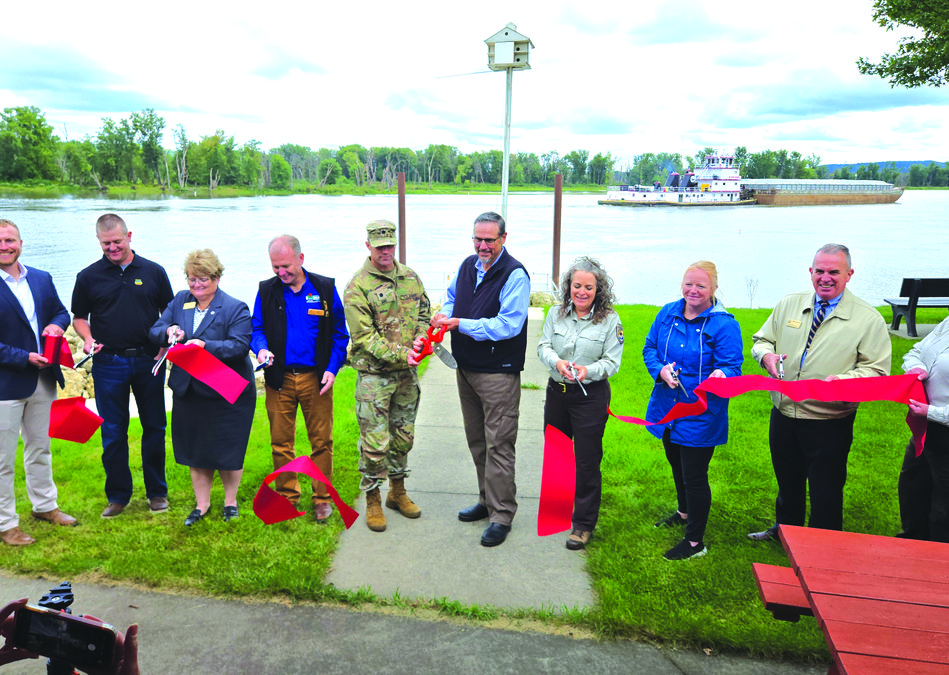
More than half a decade after the U.S. Army Corps of Engineers began restoration work on McGregor Lake, the project got a symbolic bow placed on it with a ribbon-cutting ceremony on Tuesday, Sept. 22, at 1 p.m. at the Marina Gazebo in Marquette, Iowa.
The restoration, estimated to cost around $24 million, impacted miles 633 through 635 of Pool 10 of the Mississippi River and is a collaborative effort between the Corps, Fish and Wildlife, the U.S. Department of Agriculture and the Iowa and Wisconsin Departments of Natural Resources.
“This project stands as a testament to the powerful synergy between Wisconsin, Iowa and our fellow partners,” said Eric Lobner, division administrator for the Wisconsin Department of Natural Resources. “We can’t underscore the importance of that collaboration enough of people coming together, working together and ultimately making it happen.”
Speakers at the event included Commander Joshua Rud of the U.S. Army Corps of Engineers, Iowa DNR Habitat Coordinator Ryan Hupfeld, and Upper Mississippi River Restoration Program District Program Manager John Henderson, among others from agencies like the Fish and Wildlife Service and Upper Mississippi River Basin Association.
The project started with a feasibility study completed seven years ago examining the degradation of habitat diversity due to prolonged water inundation from flooding, the reduction in tree species and wind-wave fetch erosion.
McGregor Lake before the restoration looked markedly different; according to the Corps website, the area had lost much of its vegetation due to erosion “leveling out” the barrier islands and lake bottoms.
Leveling out occurs when waves—in this case from heavy traffic on the river’s navigation channel—erode the shoreline. When sediment is pulled from dry land into the waterbed, the islands sink closer to the water line, and the lake loses depth from the added soil.
“This project was able to reverse the downward trend in the area, and we should be able to take pride in that,” said Hupfeld.
The feasibility study found that 85 percent of the trees present in the project area were of a single species, with many of the oak and ash trees dying out from excessive flooding. That left the area with a near monoculture, where a disease or parasite could come in and seriously compromise the environment’s stability. A tree fungus, for instance, could be a calamitous event for a habitat without the biodiversity to endure it.
Henderson previously said building up river islands, planting new vegetation and increasing biodiversity has proven to be a worthwhile intervention. “You get some vegetation on them, you get some trees going and they become self-sustaining after a while.”
The project also included shore stabilization, dredging, and the rehabilitation of overwintering areas in the backwaters used by fish species.
“It’s kind of scary what this area would look like without the 120,000 acres of restoration,” said Hupfeld. “Thankfully, we don’t have to see that, and it’s exciting to think about what’s coming in the future when the additional thousands of acres that we are currently planning are completed.”
Lobner also said one of the most unique characteristics of the project is its visibility—the river is one of the main byways used for recreation, industry, and travel in the Midwest. In Wisconsin alone the river contributes billions of dollars to the economy each year, and it has a similar role in the success of Iowa’s business industries as well.
“This project will not just benefit the ecosystem,” said Hupfeld. “It will also benefit the local economies and small businesses and will keep these small towns and communities thriving for decades to come.”