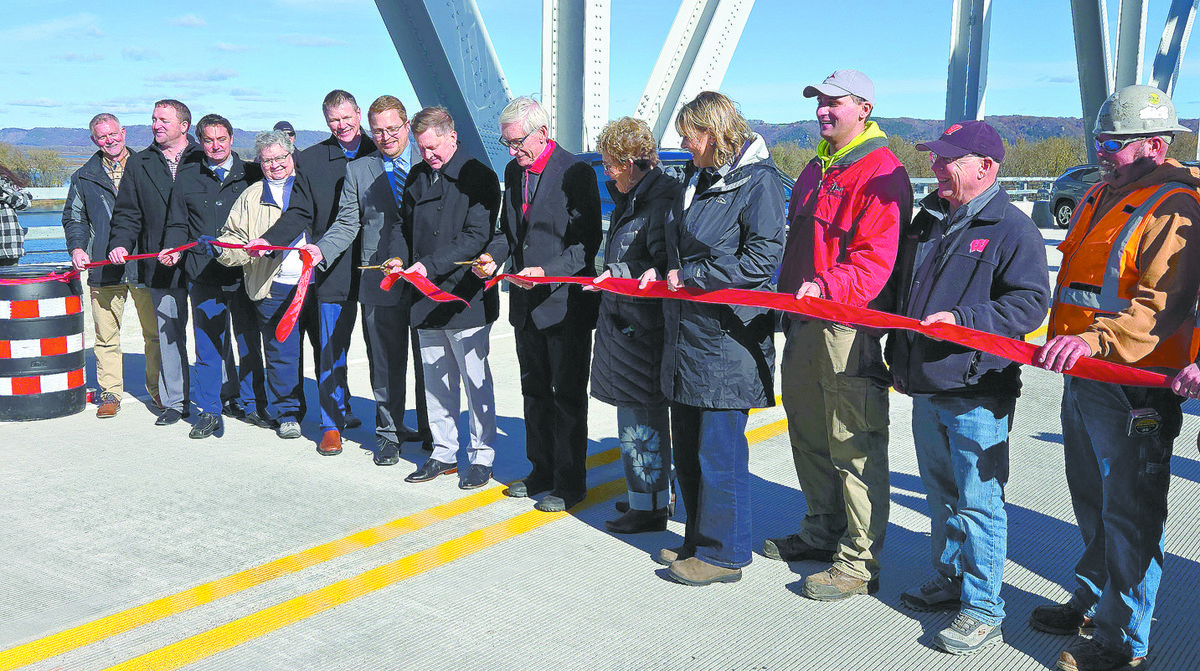
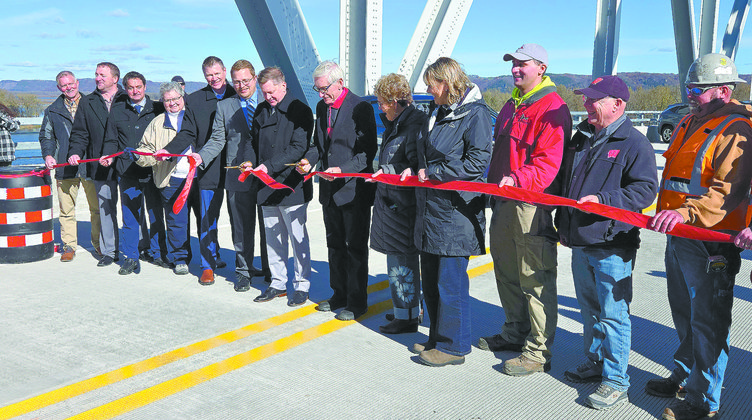
Northeast Iowa and Southwest Wisconsin are together again. This past Friday afternoon, the new Mississippi River Bridge that connects Iowa Highway 9 in Lansing, Iowa, and Wisconsin Highway 82 in Crawford County opened to traffic after a ribbon-cutting ceremony held on the bridge deck several months before the bridge was supposed to be finished.
“We expected to stand here in the spring of 2027; instead, we’re here today over five months ahead of that schedule,” said Jerry Roche, transportation safety engineer with the Federal Highway Administration. “This is a tremendous accomplishment, and it took extraordinary teams to make it happen.”
According to Clayton Burke, project manager with the Iowa Department of Transportation, they realized the project would be completed far earlier than expected approximately two months ago.
“We were really blessed with the weather,” he said. “We didn’t have too many rain days or wind days, so we made up a lot of weather days, and then to be able to pour the concrete deck and get it done before the winter was a huge help in the schedule.”
Burke said part of the reason why the bridge’s completion was expected to take until spring was that the concrete deck would not be poured before the project’s winter shutdown. “Getting that done this year allowed us to finish the concrete, the steel railing and the rest of it.”
The new bridge replaces the Black Hawk Bridge, which had connected Lansing, Iowa, to Southwest Wisconsin since 1931. It allowed cars to pass over the Mississippi River until this past year.
“There are seven bridges that connect Wisconsin to Iowa and our western neighbor states,” said Sherry Quamme, a Ferryville resident and member of the Mississippi River Parkway Commission, “and this is a critical one. In 2024, 2,300 cars per day traveled across the bridge to reach the other side… The Black Hawk Bridge [was] the artery that moves the traffic as lifeblood to the entire region and the rest of the United States of America.”
After the construction of the new bridge was announced, the original bridge experienced several temporary closures for construction work and safety concerns. The bridge closed in February 2024 after shifting was detected in the bridge’s structure and reopened in April of that year. The bridge closed to traffic permanently in October 2025. The old bridge was demolished this past December.
“Closing and removing the original bridge was a difficult decision, but we went to great measures, starting first with the water taxi and later the car ferry, to maintain these vital connections,” said Scott Marler, director of the Iowa Department of Transportation.
“We were developing models that would analyze the stress in those [bridge] members and tell us how much further they could go,” said Burke. “When we decided to close the bridge, we were at a point where we knew it was still safe for the public because it was still open, but we knew we couldn’t push the bridge any further because of those models. To continue risking movement would stress the wind bracing on the bottom of the bridge, so we had to make the tough decision.”
“This project demonstrates what can happen when governments work together, but the path to get here today was not without its challenges… That closure created real hardships,” said Wisconsin Governor Tony Evers. “Commuters, businesses, families and communities had to adjust to the loss of an essential route across the river.”
During the closure, the IowaDOT and other agencies provided transportation services to cross the river, first with a water taxi and then a car ferry. The ferry remained in operation until the bridge opened.
“This was anything but a routine project,” said Roche. “When the previous bridge began to shift and ultimately had to be closed, everyone involved had to redouble their efforts; agencies, communities and contractors had to come together and adapt to the circumstances to keep pushing forward.”
Marler said the bridge cost $165 million, with funds coming from the federal government and the states of Iowa and Wisconsin, and has a 100-year lifespan. It has a 40-foot deck with 8-foot shoulders — much larger than the Black Hawk Bridge’s 21-foot deck. More than 11,000 yards of concrete and 6,600 tons of steel were used in its construction.
“To put that into perspective: that’s close to the amount of steel that’s in the Eiffel Tower,” he said.
He added the new bridge’s foundation depth is approximately 150 feet, which is nearly three times the depth that the Black Hawk Bridge reached. “We are standing on solid rock.”
The bridge construction required the cooperation of multiple government agencies, including the Iowa and Wisconsin Departments of Transportation, the U.S. Fish and Wildlife Service and the Mississippi River Parkway Commission, among others. Kraemer North America served as the primary contractor on the bridge construction.