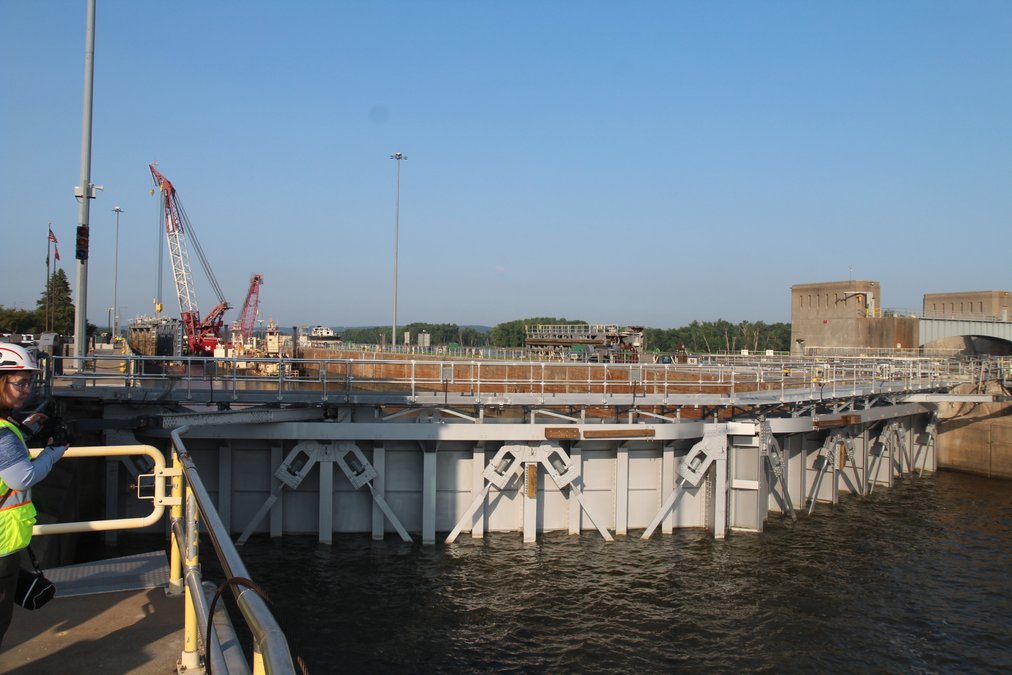
What does it take to replace a 100-ton gate on the Mississippi River?
If you’re stumped, don’t worry. Jim Cook, a project manager with the U.S. Army Corps of Engineers, can tell you all about it. He oversaw the replacement of the miter gates on Lock and Dam 9 near Lynxville that took place earlier this month.
The original gates, which are from when the lock and dam went into service in 1937, will be scrapped. The new gates are the same size as the old ones, but Cook noted there are significant differences as well.
“They’re bigger and heavier,” he said. “They fit into the same spot, so height- and width-wise, they’re the same.”
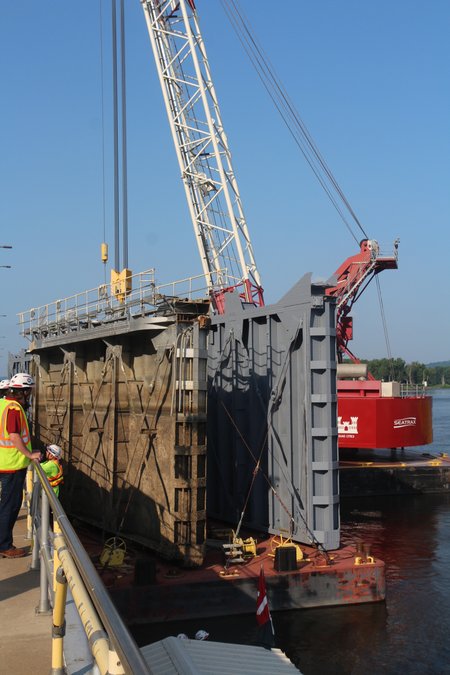
The gates are 61.5 feet long, six feet wide at their widest point, and between 27 and 33 feet tall depending on their position in the upper or lower part of the lock. The lock itself is 110 feet wide by 600 feet long.
The gates allow vessels access to the lock chamber.
They are supposed to have a 50-year lifespan, but the Corps has maintained the gates to extend their service. According to a press release from the St. Paul District, the gates have become damaged and distressed over time, reducing their serviceability.
Cook said the new gates will have greater durability to handle barge impact and high-water flow. The project includes the replacement of four gates (comprised of two leaves each) on the main chamber.


There were four 12-hour closures of the lock scheduled to complete the installations. According to Cook, the closures were done on July 14, 16, 21 and 23. The lock was open for navigation between closures.
“There’s commercial traffic that needs to move through the site. There’s recreation traffic that wants to move through, so we have a time restraint,” said Cook.
The Corps said it took G&G Steel, of Russellville, Ala., two years to assemble and fabricate the gates. Mike Holzer, a project engineer with the Corps, said the metal used to fabricate the anchorages took more than a year to obtain.
“There are only so many places that do this kind of work. It took five or six weeks to get them shipped,” said Cook.
He added that the construction and installation of the gates cost $6.8 million. Corps projects typically receive funding through annual appropriations, which are federally authorized funds accrued through taxes and fees paid by citizens.
The Corps previously conducted work on Lock and Dam 9 in late 2024 through February 2025, which included a $1.5 million project to replace the anchorages that connect the miter gates to the walls of the lock. The anchorages act as the hinges for the gates.
“It’s basically that the door frame is the same size, but the door is a lot heavier, so we had to improve the hinges so they don’t fall out of the wall,” said Cook.
Cook said replacing the gates poses some different challenges than putting in the anchorages, largely due to the sheer size of the gates. One of the project’s essential pieces of equipment is a floating crane that has a 400-ton load capacity.
“That crane comes from the Rock Island District, and that has responsibility not just for St. Paul and Rock Island. They also work for the St. Louis District and all up and down the Mississippi and Illinois waterways as well,” he said.
Crews are also using smaller cranes to move other parts, such as the pins that position each leaf of the gates.
“We’ve got another pretty substantial barge crane and cranes on the walls as well,” said Cook. “Components are so heavy that we need one crane to move the gate and keep it steady while others move the hardware to make the connections work.”
Lock and Dam 9 is one of several sites the St. Paul District maintains on the Upper Mississippi River. In 2025, nearly 1,500 commercial lockages were performed, supporting close to 5,000 barges of commodities shipped on the water. Commodities include a wide range of bulk materials, from concrete and rock to grains and other farm products.
There were approximately 1,000 fewer lockages in 2024 but about one million more tons of commodities shipped, according to data from the Corps.
Lock 9 also saw the passage of more than 2,500 recreational vehicles in 1,112 lockages and 34 additional lockages for government agency vehicles.