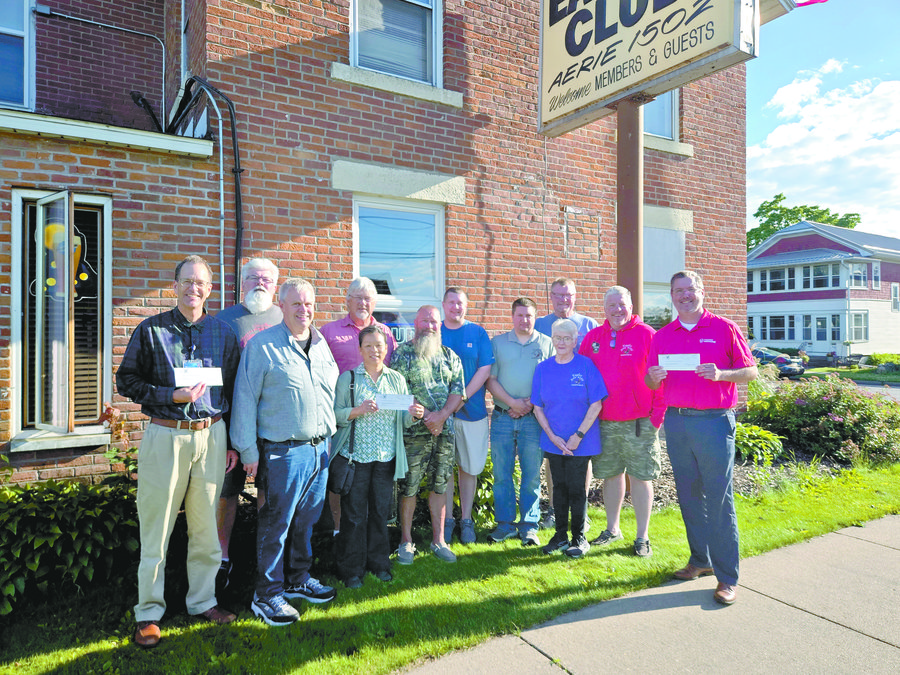
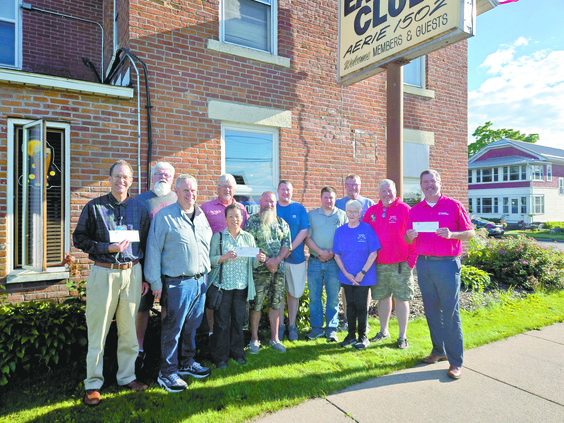
Heart and cancer research received a major boost this past Wednesday, June 17, when the Eagles Club Aerie #1502 in Prairie du Chien gave out $46,000 from the 51st Eagles Heart and Cancer Telethon.
Tom Stram, a member of the Eagles Club and one of the hosts of the telethon, presented checks for heart and cancer research to UW-Madison, Mayo Clinic and Emplify Gundersen. UW-Madison received money for their heart and cancer research centers.
Stram said the amount would be divided in half for heart and cancer research efforts.
The telethon raised more than $50,000 for their 50th event in 2025 and $37,500 in 2024. It has raised more than $1.2 million over its lifetime.
Dr. Pete Schmeling, representing UW-Madison’s Carbone Cancer Center and Cardiovascular Research Center, said the money is going toward efforts to make the heart transplant process more efficient. “Some of the research that we’re trying to do is to use AI to better match donor hearts to recipients because we need to do that really fast.”
He later elaborated on how researchers are implementing artificial intelligence to aid in heart transplants, saying, “It [puts] a lot of the different pieces together. So, they take images of the heart, clinical histories of the person donating the heart, and other things to see if they’re going to match. That stuff was previously done by hand — you got to look through all the images and the records and all that. Now, they’re using AI to do that matching faster.
“Heart transplants need to happen quickly. When someone gives that ultimate gift of life to somebody, the clock starts ticking immediately. You have to get it where it needs to go and make sure you’ve got a good match. That’s always the challenge... Anything we can do to speed up and make that a better process is beneficial.”
“Every year they donate money to help with heart research that’s going on in La Crosse,” said Mayo Clinic’s Dr. David DeHart. “One of the most recent projects they’ve been working on is helping to refine pacemakers. They’re using left-bundle pacing. In this study, they’ve found a way to accomplish the procedure more quickly, make it more efficient, and help the function even better.”
Schmeling later elaborated on the Carbone Center’s work on improving cancer treatments through precision medicine.
“One of the really exciting things we’re seeing in cancer treatment is called precision medicine,” he said. “So, rather than starting with the idea that we need to treat everyone with lung cancer the same, we’re taking a look at those tumors individually.”
Chad Abram, president of the PdC Eagles Club, said the telethon was considered a success. “We had a good year... we’ve already had a meeting, and we’re planning for our 52nd telethon.”
Abram added that the telethon is a major undertaking, and the Eagles are looking for people who want to help make their annual event better than ever. “There’s a lot of work that goes on at the school, at the club, and there’s a lot of work done before the event. So, if you’ve got some free time, look up one of us because we’d love to hand off some of those duties.”